

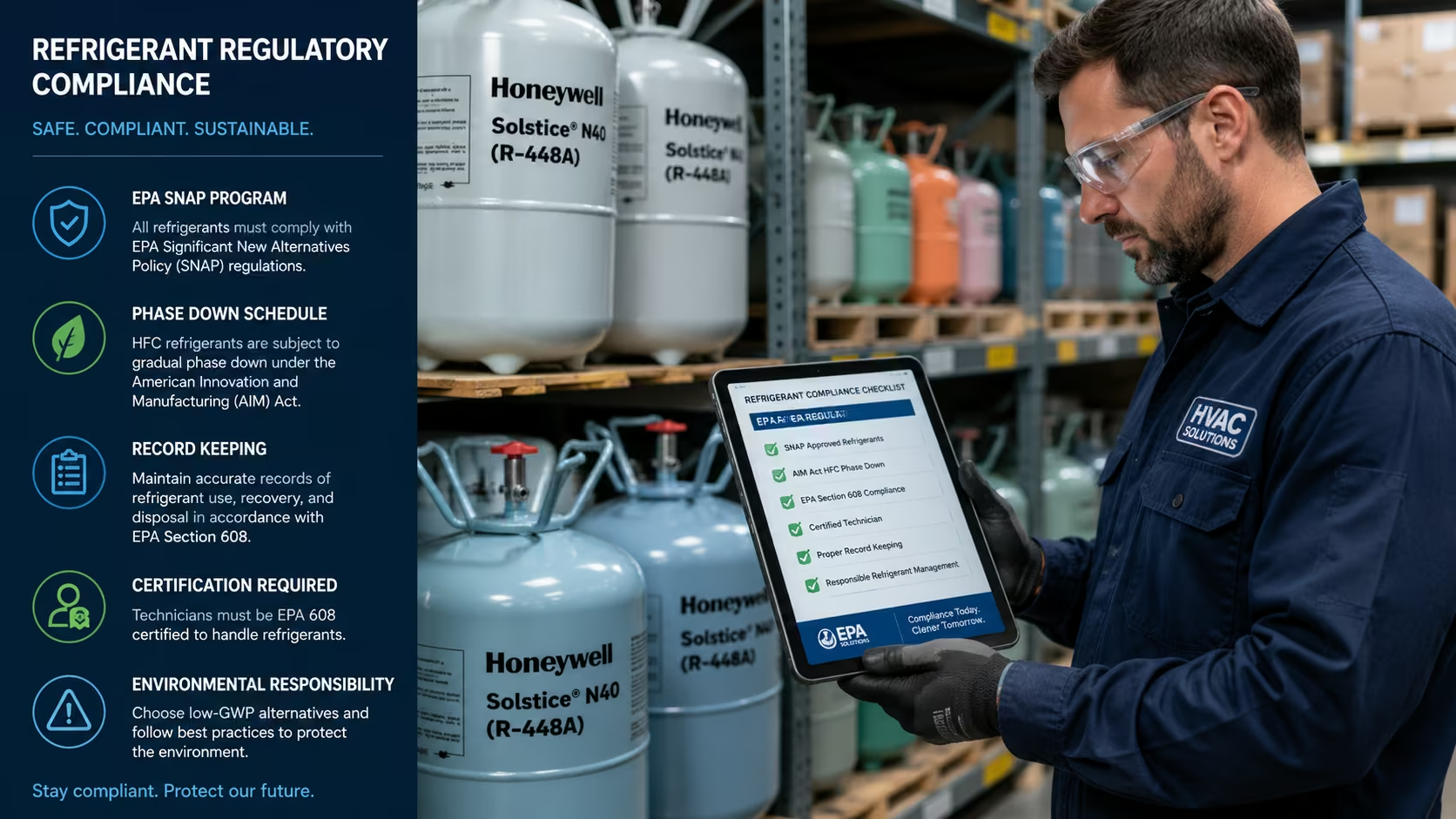
The regulatory landscape for HVAC refrigerants has changed more in the past five years than in the previous two decades. The AIM Act (American Innovation and Manufacturing Act of 2020) gave the EPA unprecedented authority to phase down high-GWP refrigerants in the United States, and the agency has been implementing that authority with increasingly specific rules affecting what refrigerants can be manufactured, sold, and used.
For HVAC contractors, distributors, and equipment manufacturers, understanding the AIM Act and its implications is no longer optional it is essential for legal compliance, equipment selection, and business planning. This guide provides a comprehensive overview of the current regulatory environment and what it means for refrigerant decisions in 2026 and beyond.
What Is the AIM Act and Why Does It Matter?
The American Innovation and Manufacturing Act was enacted by Congress in December 2020 as part of the Consolidated Appropriations Act. It authorizes the EPA to regulate hydrofluorocarbons (HFCs) the family of refrigerants that replaced ozone-depleting HCFCs and CFCs due to their significant global warming potential.
Prior to the AIM Act, legal challenges contested the EPA’s authority to regulate HFCs. The AIM Act resolved this by providing explicit Congressional authorization for EPA action, enabling a structured regulatory framework similar to what the European Union had already implemented under the F-Gas Regulations.
The Core Authority the AIM Act Gives the EPA
The AIM Act gives the EPA three primary regulatory authorities. First, it allows the EPA to establish a phasedown schedule for HFC production and consumption, targeting an 85% reduction below historical baseline levels over 15 years. Second, it allows the EPA to restrict the use of specific HFCs in certain sectors and applications where lower-GWP alternatives are available and technically feasible. Third, it allows the EPA to promote the reclamation and reuse of HFCs to extend the useful life of existing refrigerant supplies.
Together, these authorities give the EPA tools to reduce HFC emissions comprehensively, not just by limiting production but also by controlling where and how people use existing HFCs. This approach gives regulators more power than the production-only restrictions that governed previous refrigerant transitions.
How the AIM Act Differs from Previous Refrigerant Regulations
Previous refrigerant regulations in the United States focused primarily on ozone depletion (the Montreal Protocol and Clean Air Act provisions). The AIM Act focuses on climate impact (GWP), addressing a different environmental problem with a different regulatory structure.
The Montreal Protocol approach was relatively straightforward: identify ozone-depleting substances and phase out their production and import on a specific schedule. The AIM Act approach is more nuanced: establish a production phasedown while also restricting specific applications based on GWP thresholds and technology availability. This more complex approach reflects the more complex challenge of transitioning away from HFCs while maintaining the cooling systems that modern society depends upon.
The HFC Phasedown Schedule What Contractors Need to Know
The HFC phasedown under the AIM Act reduces total HFC production and consumption in the United States by 85% from a calculated baseline over 15 years. The phasedown happens in stages, with the most significant reductions concentrated in the early years.
This phasedown does not eliminate any specific HFC immediately it limits total HFC production and consumption across all uses. However, combined with the sector-specific restrictions (discussed below), the practical effect is to progressively eliminate high-GWP refrigerants from specific applications.
How the Phasedown Affects Refrigerant Availability
As total HFC production declines, the market allocation of available HFCs becomes more competitive. Refrigerant manufacturers must prioritize their production within declining allowance caps, which influences which refrigerants remain readily available and at what prices.
For HVAC contractors, this means that R-410A availability will change over the coming years. While regulators do not immediately restrict R-410A for servicing existing systems, the declining production caps will eventually constrain supply and potentially drive prices higher as demand for service refrigerant continues against a backdrop of reduced production allowances.
Implications for Refrigerant Procurement Strategies
Contractors who understand the phasedown timeline can make more informed refrigerant procurement decisions. In the near term (2026-2028), suppliers will likely continue to make R-410A available at reasonable prices for service applications. In the medium term (2028-2033), supply may tighten as production caps decline further.
Building relationships with reliable refrigerant suppliers like SmartRefrigerants.com, staying informed about regulatory developments, and maintaining appropriate inventory levels are all strategies that help contractors manage refrigerant availability risk throughout the phasedown period.
Sector-Specific Restrictions The Rules That Affect HVAC Contractors
Beyond the overall production phasedown, the AIM Act empowers the EPA to implement sector-specific restrictions that prohibit certain high-GWP refrigerants in specific applications. These restrictions impact contractors more immediately because they directly determine what refrigerants contractors can use in each type of equipment.
The most significant restriction implemented so far for the HVAC sector is the prohibition on R-410A in new residential HVAC equipment manufactured after January 1, 2026. This restriction does not affect R-410A for servicing existing equipment it only affects new equipment manufacturing.
The January 2026 New Equipment Restriction in Detail
Effective January 1, 2026, manufacturers of new residential air conditioners and heat pumps in the United States may not use refrigerants with a GWP above 700 in their products. R-410A, with a GWP of 2,088, exceeds this threshold and manufacturers cannot use it in new equipment they manufacture after this date.
This restriction has been implemented by equipment manufacturers transitioning their product lines to lower-GWP refrigerants including R-454B (GWP 466) and R-32 (GWP 675). Both of these refrigerants are classified as A2L (mildly flammable), which required equipment redesign to incorporate appropriate safety features.
What the January 2026 Restriction Means for Installation Contractors
For installation contractors, the January 2026 restriction means that new equipment being installed in residential applications now uses R-454B or R-32, not R-410A. This has several practical implications.
Contractors must stock R-454B in addition to R-410A. They must train technicians in A2L refrigerant handling protocols. They must use properly calibrated gauges and service equipment for the new refrigerant types. And they must be able to communicate clearly to customers about why new equipment uses a different refrigerant than their old system.
Refrigerant GWP Thresholds by Application
The EPA’s AIM Act regulations establish different GWP thresholds for different application categories. Understanding these thresholds helps contractors and facility managers select compliant refrigerants for their specific applications.
For residential air conditioning (split systems, packaged units, heat pumps): GWP limit of 700 for new equipment manufactured after January 1, 2026. R-454B (GWP 466) and R-32 (GWP 675) comply; R-410A (GWP 2,088) does not for new equipment.
Commercial HVAC GWP Requirements
For commercial HVAC applications including large commercial air conditioning and heat pump systems, the GWP requirements follow a different schedule and threshold than residential systems. The EPA has been developing sector-specific rules for commercial applications, and contractors who serve commercial HVAC markets should monitor EPA rulemaking activity for updated requirements.
As general guidance, the industry increasingly prefers lower-GWP refrigerants in commercial HVAC applications for both regulatory compliance and to prepare for tightening requirements. Commercial systems that use R-454B, R-32, and similar low-GWP alternatives remain better positioned for long-term regulatory stability.
Commercial Refrigeration GWP Requirements
Refrigeration (supermarkets, cold storage, food service) faces some of the most challenging GWP requirements due to the very high GWP values of the refrigerants currently used (R-404A at 3,922). California has already banned virgin R-404A, and the EPA’s framework anticipates further restrictions at the federal level.
For commercial refrigeration applications, lower-GWP alternatives including R-448A (GWP ~1,387), R-449A (GWP ~1,397), and R-452A (GWP ~2,140) are appropriate transition choices. These alternatives reduce GWP significantly while maintaining performance in commercial refrigeration applications.
Section 608 Requirements What Has Not Changed
While the AIM Act introduced significant new regulatory authority, it did not eliminate or supersede the existing EPA Section 608 regulatory framework. Section 608 requirements remain in full effect and continue to govern refrigerant handling, recovery, and technician certification.
Section 608 requires technicians who service refrigeration equipment to hold appropriate EPA certification. The EPA organizes certification into four types based on the equipment worked on: Type I (small appliances), Type II (high-pressure systems), Type III (low-pressure systems), and Universal (all types). Most residential and commercial HVAC technicians hold Universal certification.
Recovery Requirements Under Section 608
The Section 608 requirement to recover refrigerant from systems before any service, repair, or disposal remains in full force. Technicians must recover refrigerant using certified recovery equipment and must achieve evacuation levels that the regulations specify for the system type and refrigerant.
This requirement applies to all refrigerants regulated under Section 608, including R-410A, R-454B, R-404A, R-22, and all their alternatives. No technician, regardless of how minor they believe the service to be, is exempt from the recovery requirement if they are working on a refrigerant-containing system.
Record-Keeping and Reporting Requirements
The Section 608 requirement to recover refrigerant from systems before any service, repair, or disposal remains in full force. Technicians must perform recovery using certified recovery equipment and must achieve the evacuation levels that the regulations specify for the system type and refrigerant.
The AIM Act adds an additional layer of reporting requirements for refrigerant manufacturers and importers who must track HFC production and consumption against their phasedown allowances. While these requirements primarily affect manufacturers and importers, contractors benefit from understanding that their refrigerant purchases are part of a tracked national system.
Planning for Compliance Practical Steps for Contractors
Understanding the regulatory framework is necessary but not sufficient. Contractors must translate that understanding into concrete business actions that maintain compliance and position the business for success in a changing market.
The first priority is technician training. HVAC technicians who will work on new equipment must now master A2L refrigerant handling protocols as essential skills. Organizations such as ACCA, ASHRAE, RSES, and equipment manufacturers provide training resources. Contractors who invest in training now become better prepared as A2L equipment proliferates.
Equipment and Tool Updates for A2L Compliance
Servicing A2L refrigerant systems requires tools and equipment appropriate for the refrigerant type. Technicians must calibrate manifold gauges for the pressure-temperature characteristics of the specific refrigerant. Manufacturers must approve recovery equipment for A2L refrigerant recovery. Technicians must use leak detectors that are sensitive to the specific refrigerant in use.
Some existing R-410A equipment is compatible with R-454B service; other equipment is not. Contractors should audit their tool inventory for A2L compatibility and plan purchases accordingly. Equipment manufacturers provide compatibility documentation that helps contractors make informed decisions about which tools to upgrade.
Supplier Relationships and Inventory Management
Refrigerant supply is increasingly complex as the market transitions. Contractors who maintain relationships with reliable suppliers like SmartRefrigerants.com benefit from supply certainty, product authenticity assurance, and access to the full range of refrigerants needed to serve a diverse customer base.
Inventory management should reflect the current and near-term demand profile of the contractor’s service market. A contractor serving primarily residential customers should ensure adequate R-454B stock for new equipment service while maintaining R-410A for the large installed base. A contractor serving commercial refrigeration should maintain R-448A alongside R-404A.
8 Frequently Asked Questions About AIM Act and HVAC Refrigerant Regulations
Q1: What is the AIM Act?
The American Innovation and Manufacturing Act is a 2020 federal law authorizing the EPA to phase down HFC refrigerants in the United States by 85% from baseline levels over 15 years.
Q2: Can I still use R-410A to service existing systems?
Yes. R-410A remains legal and available for servicing existing systems. The January 2026 restriction only applies to new equipment manufacturing.
Q3: What refrigerant must new residential AC use after January 2026?
New residential AC and heat pump equipment manufactured after January 1, 2026 must use refrigerants with GWP below 700. R-454B (GWP 466) and R-32 (GWP 675) are the primary options.
Q4: Is R-404A banned in the US?
Virginia R-404A is banned in California as of January 2026. Federal restrictions are expected to follow. Virgin R-404A remains legal in other states currently.
Q5: Do I need recertification for A2L refrigerants?
Current EPA Section 608 certification covers work with A2L refrigerants. However, additional manufacturer and industry training on A2L handling protocols is strongly recommended and may be required by some states.
Q6: How do I know if my refrigerant purchase is AIM Act compliant?
Purchase from reputable suppliers who source refrigerant from licensed manufacturers and distributors. SmartRefrigerants.com supplies compliant refrigerants with appropriate documentation.
Q7: What records must I keep for refrigerant use?
Section 608 requires purchase and use records kept for at least three years. For systems over 50 lbs charge, repair and inspection records are also required.
Q8: Where can I get compliant refrigerant for all my service needs?
SmartRefrigerants.com stocks the full range of compliant refrigerants including R-454B, R-410A, R-448A, R-407C, R-404A, and more, with fast nationwide shipping and proper documentation.
Conclusion
The AIM Act has permanently changed the regulatory landscape for HVAC refrigerants in the United States. The phasedown of HFCs, the sector-specific application restrictions, and the EPA’s expanding regulatory authority represent a fundamental shift that every contractor, facility manager, and refrigerant professional must understand and plan for.
Compliance is not a burden to avoid it is a framework that protects legitimate businesses, creates a level playing field, and drives the industry toward more sustainable practices. Contractors who embrace this regulatory transition, invest in training, and build supply relationships with compliant sources like SmartRefrigerants will be well positioned to serve their markets profitably through this period of change.