

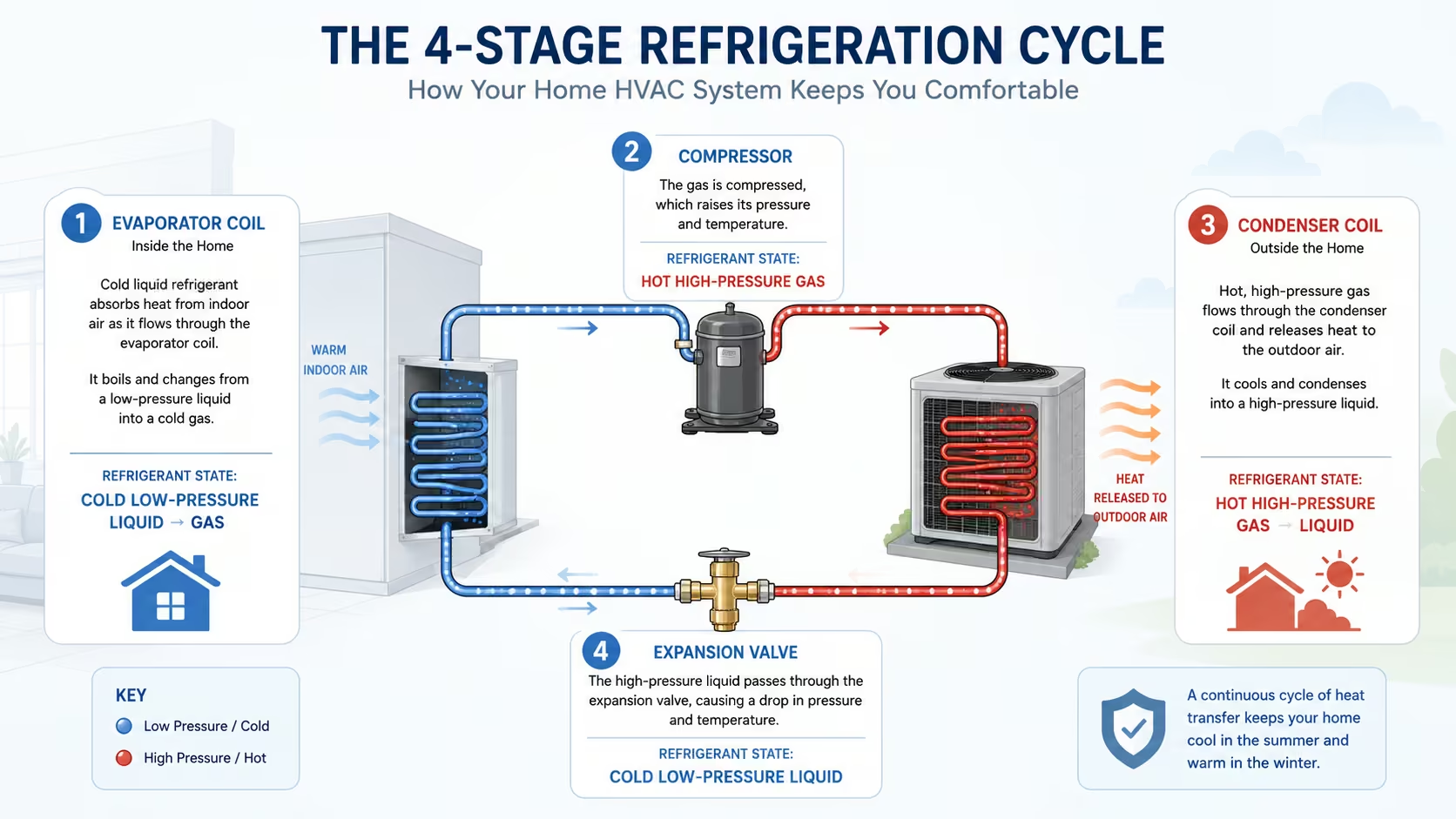
HVAC refrigerants are the lifeblood of every air conditioner and heat pump. Without them, your system simply cannot move heat and your home stays hot in summer and cold in winter. Yet most homeowners have no idea what type of HVAC refrigerant is running through their system, what it does, or why it matters so much right now. In this guide, you will learn how refrigerant works in AC, the different types of HVAC refrigerant from R-22 to the newest A2L options, and exactly what the 2026 industry shift means for your residential HVAC refrigerant. Whether you own an older system or you are shopping for a new one, this article gives you everything you need to make smart decisions.
What Are HVAC Refrigerants?
The Basic Job of Refrigerant
An HVAC refrigerant is a special chemical compound that travels through a closed loop inside your air conditioning or heat pump system. It never gets used up. Instead, it keeps cycling absorbing heat from inside your home and releasing it outside. Think of it like a shuttle bus that picks up heat in one place and drops it off somewhere else, over and over again.
How the Refrigeration Cycle Actually Works
The secret behind how refrigerant works in AC is its very low boiling point. Most refrigerants boil at temperatures far below freezing sometimes as low as -40°F. Because of this, even at normal room temperature, the refrigerant wants to turn from liquid to gas. When it does, it absorbs a large amount of heat in the process. That is exactly why your air feels cool when it blows across the evaporator coil inside your home. After that, the refrigerant travels outdoors, where the compressor pressurizes it back into a hot liquid, releasing that captured heat to the outside air. This heat transfer process is what makes refrigerant-based cooling far more energy-efficient than simple electric resistance heating.
Why the Right Type and Charge Level Both Matter
Beyond understanding how refrigerant works, it is equally important to understand that the correct refrigerant type and the correct charge level both matter a great deal. Using the wrong type of refrigerant damages seals, lubricants, and critical components like the compressor. Similarly, an incorrect refrigerant charge level whether too low or too high hurts efficiency and puts your system at risk of serious and expensive compressor damage. For these reasons, always let a certified technician handle all refrigerant work.
The History of HVAC Refrigerants
The Early Era: CFCs and HCFCs
The story of HVAC refrigerants begins with a family of chemicals called CFCs chlorofluorocarbons. The most famous of these was R-12, better known by the brand name Freon. After that came HCFCs like R-22, which became the residential standard for decades. These refrigerants had excellent thermodynamic properties, meaning they moved heat efficiently and worked well across a wide range of temperatures. For a long time, they seemed like the perfect solution.
The Ozone Crisis and the Montreal Protocol
Then scientists discovered a major problem. CFCs and HCFCs were destroying the ozone layer the atmospheric shield that protects all living things from harmful ultraviolet radiation. The international community responded fast. In 1987, countries around the world signed the Montreal Protocol, agreeing to phase out ozone-depleting refrigerants. As a direct result, the US phased out R-12 in the 1990s and then banned R-22 in new equipment by 2010, with a full production and import ban taking effect in 2020. The R-22 phase out was one of the most significant regulatory changes in HVAC history.
The Rise of R-410A and the GWP Problem
As R-22 disappeared from the market, R-410A sold under the brand name Puron stepped in as the new residential standard starting around 2006. R-410A solved the ozone problem because it contains no chlorine. However, it introduced a new concern: a very high global warming potential refrigerant rating of 2,088. In practical terms, that means one pound of R-410A leaking into the atmosphere has the same warming effect as 2,088 pounds of carbon dioxide.
The Kigali Amendment and the AIM Act
The regulatory response came next. The Kigali Amendment in 2016 added HFC phasedowns to the Montreal Protocol framework. Then, in the US, Congress passed the AIM Act in 2020, giving the EPA authority to phase down high-GWP refrigerants. As a result of these combined regulations, R-410A was banned in new residential equipment starting January 2025. Low-GWP refrigerant alternatives like R-454B and R-32 are now taking its place. The shift is well underway, and the industry has adapted quickly.
Here is a quick reference timeline so you can see how these changes unfolded:
| Year | Event |
| 1987 | Montreal Protocol signed global agreement to phase out ozone-depleting substances |
| 1990s | R-12 (Freon) phased out of new equipment worldwide |
| 2006 | R-410A becomes the dominant US residential refrigerant |
| 2010 | R-22 banned in new HVAC equipment in the United States |
| 2016 | Kigali Amendment adds HFC phasedown to the Montreal Protocol |
| 2020 | R-22 production and import fully banned; AIM Act signed into US law |
| 2025 | R-410A banned in new residential equipment; R-454B and R-32 become the new standard |
HVAC Refrigerants List: Most Common Types Used Today
One important fact to understand before diving in: the type of refrigerant your HVAC system uses is set at the factory. You cannot swap refrigerants without replacing major components. In fact, mixing different refrigerants damages seals, breaks down lubricants, and can destroy the compressor entirely. With that in mind, the comparison table below gives you a quick overview of the most common refrigerants, followed by plain-language explanations of each one.
| Refrigerant | Common Name | GWP | Ozone Impact | Flammability | Application | Status |
| R-22 | Freon | 1,810 | High (HCFC) | A1 – Non-flammable | Pre-2010 residential | Banned in new equipment (2010); service only |
| R-410A | Puron | 2,088 | None (HFC) | A1 – Non-flammable | Residential split (2006–2024) | Banned in new equipment (2025); service continues |
| R-454B | Puron Advance | 466 | None (HFO blend) | A2L – Mildly flammable | New residential split systems | Required in new US residential systems (2025+) |
| R-32 | — | 675 | None (HFC) | A2L – Mildly flammable | Mini-splits, new central systems | Widely used globally; growing in US |
| R-290 | Propane | 3 | None (natural) | A3 – Highly flammable | Small commercial, some window units | Limited use; charge restrictions apply |
| R-134a | — | 1,430 | None (HFC) | A1 – Non-flammable | Automotive AC (older) | Being replaced by R-1234yf |
| R-1234yf | — | 4 | None (HFO) | A2L – Mildly flammable | Automotive AC (current standard) | Active and growing |
R-22 (Freon) The Phased-Out Standard
R-22 refrigerant, commonly called Freon, was the dominant refrigerant in US residential air conditioners from roughly the 1970s through 2010. If your system is more than 15 years old, there is a very good chance it runs on R-22. However, the R-22 phase out is now complete. No new R-22 has been manufactured or imported in the US since January 2020. As a result, only recycled and reclaimed stock is legally available for service.
That scarcity drives prices up sharply. R-22 can now cost several times more per pound than R-410A did at its peak price. Consequently, a single recharge on a leaking R-22 system can run anywhere from $400 to over $1,000 depending on how much refrigerant it needs. And here is the critical point: recharging without fixing the underlying refrigerant leak just delays the problem and wastes money. Moreover, if your system is 10 years or older and starts developing leaks, replacement is almost always the smarter financial decision.
That said, some R-22 systems can be retrofitted with alternative refrigerants like R-407C. However, this process requires a full oil flush and careful component inspection, and results are not always reliable. For that reason, most HVAC professionals recommend full replacement over retrofitting for systems of any significant age.
For a complete look at R-22 and your options today, read our detailed R-22 Refrigerant Phase-Out Guide, which covers retrofit decisions, cost comparisons, and exactly when replacement makes more sense than repair.
R-410A (Puron) The Workhorse Being Phased Down
R-410A refrigerant, sold as Puron, replaced R-22 as the residential standard because it contains no chlorine, meaning it causes no ozone depletion. It worked extremely well and, as a result, became the system of choice for virtually every residential split system installed between 2006 and early 2025. However, its GWP of 2,088 made it a target under the AIM Act, and the R-410A phase out for new residential equipment manufacturing took effect in January 2025.
If you own an R-410A system today, the good news is that you do not need to take any immediate action. R-410A will remain available for servicing existing systems for many years to come. Prices may gradually rise as supply tightens, but there is no crisis scenario like what happened with R-22. One important technical note worth knowing: R-410A operates at significantly higher pressures than R-22. This is one reason you cannot mix refrigerants or swap components between systems the tools, gauges, and fittings are all rated differently. The same compatibility concern applies as the industry moves to the new A2L refrigerants.
R-454B (Puron Advance) The R-410A Replacement for New Systems
R-454B refrigerant, branded as Puron Advance, is the refrigerant you will find in most new residential central air conditioners and heat pumps installed in the US from 2025 onward. It is a blend of R-32 and R-1234yf, and it delivers a GWP of just 466 roughly 78% lower than R-410A. Most major North American manufacturers chose R-454B as their primary R-410A replacement because its pressure profile is closer to R-410A than R-32 alone. That meant manufacturers could retool existing product lines with considerably less redesign effort.
R-454B carries an A2L safety classification, which means it is mildly flammable. This sounds alarming at first, but it is not cause for concern. A2L means the refrigerant has a very slow flame speed and will not ignite easily under normal conditions. It is nothing like propane (A3) or natural gas. To break it down further: the “A” means non-toxic, the “2” means lower flammability than a highly dangerous gas, and the “L” means the flame speed is slow. In a properly designed and installed residential system, the risk to homeowners is essentially zero. That said, technicians do need specific A2L training and updated tools to work with these refrigerants safely.
R-32 The Efficient Single-Component Alternative
R-32 refrigerant is actually one of the two components already inside R-410A. Used on its own, R-32 has a GWP of 675 and delivers excellent energy efficiency in fact, it requires less refrigerant charge per unit of cooling than R-410A because it has better heat capacity per unit mass. As a result, R-32 is widely used in mini-split systems globally and is growing in use for central systems in the US. Like R-454B, it carries an A2L classification. If you are buying a new ductless mini-split system today, there is a good chance it already uses R-32.
R-290 (Propane) The Natural Refrigerant Option
R-290, or propane, has an almost negligible GWP of just 3 and outstanding thermodynamic performance. However, its A3 highly flammable classification significantly limits its practical use. Charge amounts are typically restricted to 150 grams or less for safety reasons, which works for small commercial refrigeration units and some window air conditioners but makes it unsuitable for large central AC systems. Because of these flammability and building code restrictions, R-290 is unlikely to become a common residential refrigerant in the near future.
Other Refrigerants Worth Knowing
A few additional refrigerants come up in conversation and are worth a brief mention:
- R-134a the older automotive AC standard, now being replaced by R-1234yf in new vehicles. • R-1234yf the current automotive standard with a GWP of just 4. It is A2L classified and widely used in newer car models. • CO2 / R-744 used in industrial refrigeration and some heat pump water heaters. GWP of 1, but it operates at extremely high pressures. • Ammonia / R-717 found in large industrial cold storage. GWP of 0, but it is toxic and never used in residential systems.
Current HVAC Refrigerants in Residential Systems
How to Find Out What Refrigerant Your System Uses
Not sure what refrigerant is in your own AC? The answer is easier to find than most people expect. Start with a simple check: look for the nameplate sticker on the side of your outdoor condenser unit it is usually on the side panel or near the service ports. The sticker lists the refrigerant type as “Refrigerant” followed by the designation, such as “R-410A” or “R-22.” If you cannot find the sticker, the installation manual inside the air handler also typically lists this information.
Using Your System’s Age as a Guide
If you do not have access to the nameplate, the age of your system gives you a very reliable guide. Systems installed before 2010 almost certainly use R-22, while those installed between 2010 and late 2024 typically use R-410A. Units installed in 2025 or later will use either R-454B or R-32. Knowing what refrigerant your AC uses is more important than ever right now, because servicing costs and parts availability vary significantly between these three generations of refrigerants.
Why Refrigerant Compatibility Is Non-Negotiable
Beyond simply knowing your refrigerant type, it is critical to understand that refrigerant compatibility is not optional. Using the wrong refrigerant in your system even in a well-intentioned attempt to top it off damages seals, breaks down the lubricating oil inside the compressor, and can void your warranty entirely. This is precisely why refrigerant work must always be performed by a certified technician.
Signs Your System Has a Refrigerant Problem
If your refrigerant charge level drops, your system will start giving you clear signals. Watch for these low refrigerant symptoms:
- Your AC runs constantly but never quite reaches your thermostat setting • Ice forms on the refrigerant lines or on the evaporator coil inside the air handler • Cooling feels noticeably weaker than it did in previous seasons • You hear a hissing or bubbling sound near the refrigerant lines or outdoor unit this often signals an active refrigerant leak • Your electricity bills creep up without any other obvious explanation • Your home feels humid and clammy even though the AC is running low refrigerant prevents the evaporator coil from getting cold enough to remove moisture from the air effectively
The Truth About Refrigerant Leaks and Recharging
Here is something most people do not realize: refrigerant is not consumed like gasoline. It circulates in a closed loop. Therefore, if the level drops, there is always a leak somewhere in the system. The right fix is to find and repair the leak first, then recharge the system to the manufacturer’s specified level. Simply topping off a leaky system without repairing it wastes money and delays a problem that will only get worse over time.
The Overcharge Problem: Often Overlooked
It is also worth knowing that an overcharged system is just as harmful as an undercharged one. When too much refrigerant is added which often happens when uncertified people try to “top off” without knowing the correct charge the system runs at abnormally high head pressure, stresses the compressor, and loses efficiency. This is a common outcome of DIY refrigerant attempts and one that can lead to premature compressor failure. Both overcharge and undercharge are situations that only a certified technician should diagnose and correct.
EPA Rules: Who Can Legally Handle Refrigerant
Finally, it is important to understand who can legally purchase and handle refrigerant. The EPA requires Section 608 certification for the purchase of refrigerants with a GWP above 150. All regulated refrigerants currently in HVAC use fall into this category. As a result, homeowners cannot legally buy or handle these refrigerants themselves. All refrigerant work must be performed by a certified technician.
For more on certification and regulations, see our HVAC Refrigerant Certification Guide it covers Section 608 requirements, what certified technicians are trained to do, and why these regulations protect both homeowners and the environment.
New HVAC Refrigerants Shaping the Future
The AIM Act: The Regulation Driving Change
The biggest driver of change in refrigerants right now is the AIM Act phasedown timeline. Starting January 2025, manufacturers can no longer produce new residential air conditioning and heat pump equipment that uses R-410A. The industry has moved decisively toward lower-GWP alternatives, and that transition is already well underway across all major brands.
Understanding A2L Refrigerants in Plain Language
The near-term future belongs to A2L refrigerants. It helps to understand what A2L actually means in practical terms. “A” means non-toxic. “2” means lower flammability not high-risk like A3 propane. “L” means the flame speed is slow. So a homeowner with a new R-454B system does not need to treat their home like a gas leak situation. The risk in a properly installed, code-compliant residential system is genuinely minimal. That said, HVAC technicians do need A2L-specific training and updated service equipment to handle these refrigerants correctly and safely.
Why the Industry Chose R-454B for North American Systems
R-454B has become the primary choice for North American unitary systems the central air conditioners and heat pumps most commonly found in homes. Most major US brands chose R-454B over R-32 for a very practical reason: R-454B’s pressure profile is closer to R-410A than R-32 is. That meant manufacturers could redesign existing product lines with significantly less retooling, which accelerated the transition and kept costs lower. Despite having a slightly higher GWP than R-32, R-454B still represents a 78% reduction from R-410A a substantial environmental improvement.
R-32’s Growing Role Globally and in the US
Meanwhile, R-32 is already dominant in mini-split systems globally. Unlike R-454B, it is a single-component refrigerant rather than a blend, which makes it somewhat simpler to handle and reclaim. Its GWP of 675 is meaningfully lower than R-410A’s 2,088. As A2L installation practices become more common among US technicians, R-32 adoption in central systems is expected to continue growing.
What New Refrigerants Mean for Homeowners Buying Today
If you are buying a new system in 2025 or later, expect R-454B or R-32. Before signing any contract, ask your contractor specifically which refrigerant the unit uses and confirm that your installation team is trained in A2L handling procedures. Importantly, these new refrigerants deliver equivalent or better energy efficiency compared to R-410A, so there is no performance trade-off involved in choosing a new system.
Long-Term Service Costs: No Need to Panic
Finally, here is some reassurance on long-term service costs. The R-22 situation became painful specifically because of a total production ban supply dried up and prices skyrocketed as a direct consequence. R-454B and R-32, however, face no such ban. They will be widely manufactured for the foreseeable future. Homeowners buying new systems today should not worry about future refrigerant supply or service costs.
Which HVAC Refrigerant Is Right for Your System?
If You Have a System Using R-22
If your system runs on R-22 and it is 10 or more years old, replacement is almost certainly the better financial decision. Here is why: the cost of R-22 itself continues to rise as recycled supply shrinks. A single recharge can cost hundreds to over a thousand dollars. And if your system has a leak which is the reason the refrigerant ran low in the first place that money does not fix the underlying problem. Additionally, older R-22 systems are far less energy-efficient than modern equipment, so replacement often pays for itself through lower electricity bills over time.
Your main options are:
- Option 1: Repair and recharge only makes sense if the system is relatively young and the leak repair is straightforward. • Option 2: Retrofit to R-407C or similar possible on some systems but requires a full oil flush and comes with reliability trade-offs. Most professionals do not recommend this as a long-term solution. • Option 3: Full system replacement almost always the smartest choice for systems over 10 years old. New systems use R-454B or R-32 and deliver significantly better efficiency.
If you need a replacement refrigerant cylinder for an existing R-22 system while you plan your next steps, R-22 Refrigerant 30lb Cylinder is available for certified technicians. Always work with a licensed professional for any refrigerant purchase and service.
If You Have a System Using R-410A
The good news here is that you do not need to do anything right now. R-410A systems will continue to be serviced with R-410A for many years. Supply will remain available, though prices may gradually increase as production winds down. When your system eventually needs replacement, the new system will simply use a different refrigerant that transition is completely normal and fully handled by your HVAC contractor. The one thing to avoid in the meantime: never allow anyone to charge an R-410A system with R-32 or R-454B. They are not compatible and the damage can be severe.
If your technician needs to service your existing system, R-410A 25lb Honeywell Refrigerant is available in our shop for certified professionals.
If You Are Buying a New System in 2025 or Later
Expect R-454B or R-32. Before signing a contract, ask your contractor two straightforward questions: what refrigerant does this specific unit use, and is your team trained and certified for A2L refrigerant handling? New refrigerants perform equivalently or better than R-410A in terms of cooling and efficiency. There is no performance compromise. What does change is that A2L systems require specific installation practices and equipment so always make sure your installer is current on A2L procedures.
Frequently Asked Questions About HVAC Refrigerants
What is HVAC refrigerant and what does it do?
An HVAC refrigerant is a chemical compound that circulates in a closed loop inside your air conditioning or heat pump system. It absorbs heat from inside your home, carries it outside, and releases it then repeats the cycle continuously. Refrigerant is never consumed or used up; if levels drop, it always means there is a leak somewhere in the system.
What are the most common types of HVAC refrigerant?
The most common types today are R-22 (now phased out, service only), R-410A (being phased down, still in millions of existing systems), R-454B (Puron Advance, the new residential standard from 2025), and R-32 (widely used in mini-splits and growing in central systems). Each has a different GWP, flammability rating, and set of applications.
How do I know what refrigerant my AC uses?
Check the nameplate sticker on your outdoor condenser unit it lists the refrigerant type directly. As a general guide: pre-2010 systems almost always use R-22; systems from 2010 to 2024 almost always use R-410A; systems from 2025 onward will use R-454B or R-32.
What are the signs of low refrigerant in an AC system?
Key low refrigerant symptoms include: the system runs constantly without reaching your target temperature; ice forms on the evaporator coil or refrigerant lines; cooling is noticeably weaker than in previous seasons; you hear hissing or bubbling near the outdoor unit; your electricity bills rise unexpectedly; and your home feels unusually humid even with the AC running.
Why is R-22 refrigerant so expensive now?
R-22 production and import were fully banned in 2020 as part of the R-22 phase out under the Montreal Protocol. Only recycled and reclaimed stock remains available, and as that supply continues to shrink, prices keep rising. They will continue to rise over time, which is one key reason replacement makes more financial sense than ongoing recharging for older R-22 systems.
Can I add refrigerant to my AC myself?
No. The EPA requires Section 608 certification to purchase refrigerants with a GWP above 150 which covers all refrigerants currently used in HVAC systems. Attempting to recharge a system without certification is illegal, and without proper training it is also dangerous and likely to damage the equipment. Always hire a certified technician.
What refrigerant do new air conditioners use after 2025?
New residential air conditioners and heat pumps in the US primarily use R-454B (Puron Advance) or R-32. Both are A2L classified, meaning they are mildly flammable but not dangerous in properly installed systems. Both also have much lower GWP values than R-410A.
Does refrigerant need to be replaced regularly?
No. Refrigerant circulates in a closed loop and is not consumed during normal operation. If the level in your system drops, it always means there is a leak that needs to be found and repaired. The correct solution is to fix the leak first, then recharge to the manufacturer’s specified level not to simply “top off” repeatedly.
What is GWP and why does it matter for refrigerants?
GWP stands for Global Warming Potential. It measures how much a substance warms the atmosphere compared to carbon dioxide over 100 years. R-22 has a GWP of 1,810. R-410A is 2,088. R-454B is 466. R-32 is 675. The lower the GWP, the less climate impact if the refrigerant ever leaks from a system. Global regulations now drive the industry toward lower-GWP refrigerant options.
The Bottom Line on HVAC Refrigerants
HVAC refrigerants have changed a lot over the past few decades, and they are changing again right now. The good news is that the new generation of refrigerants R-454B and R-32 delivers excellent performance with a much smaller environmental footprint. Whether you own a system today or are buying a new one, knowing your refrigerant type, keeping an eye on the signs of trouble, and always working with a certified technician puts you in the best possible position for the long term.
If you need refrigerant for a certified service job or want to explore current inventory, visit Smart Refrigerants’ shop for a wide selection of professional-grade options at competitive prices.