

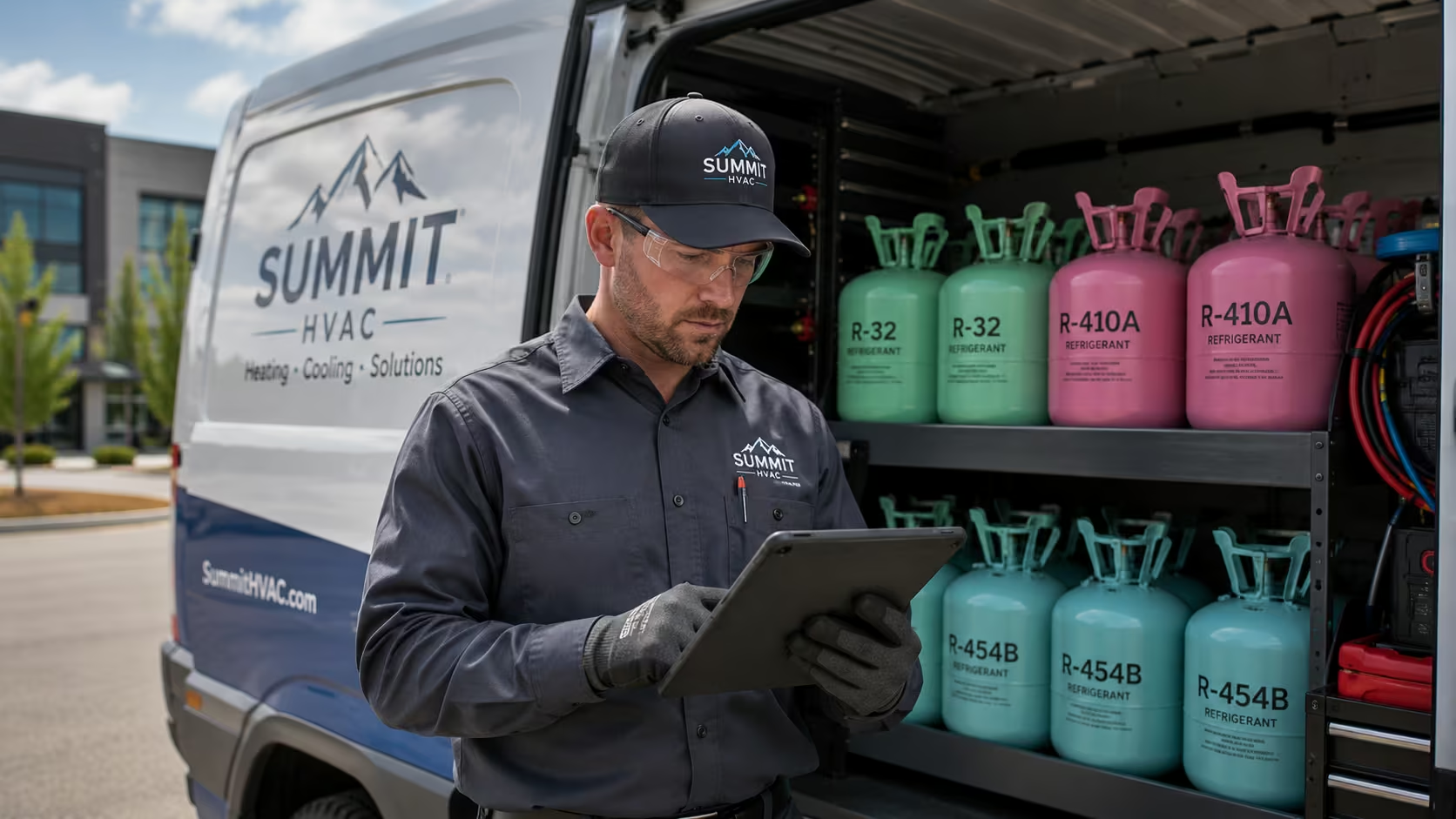
The HVAC industry has navigated refrigerant transitions before. The shift from R-12 to R-134a in automotive systems and from R-22 to R-410A in residential HVAC were both significant industry changes. But the current transition driven by the AIM Act is arguably the most complex and far-reaching the industry has ever experienced. Multiple refrigerants are transitioning at once, new safety classifications are involved, and the timeline for compliance is both firm and fast-moving.
Contractors who approach the HVAC refrigerant transition reactively waiting until customers ask questions or until equipment issues force the conversation will find themselves behind schedule, underprepared, and losing business to better-prepared competitors. Contractors who approach it proactively building knowledge, updating tools, training teams, and stocking the right refrigerants will find significant opportunity in the transition. This guide provides a practical framework for doing exactly that.
Understanding the Current Refrigerant Transition Landscape
The AIM Act (American Innovation and Manufacturing Act), signed in December 2020, authorizes the EPA to phase down hydrofluorocarbons (HFCs) based on their global warming potential. The phase-down is measured in CO2 equivalent production and consumption, with specific percentage reductions mandated at defined milestones. By 2036, US HFC production and consumption must be 85% lower than the 2011–2013 baseline.
The practical impact on contractors started with restrictions on high-GWP refrigerants in new equipment. Beginning January 1, 2026, regulations prohibit refrigerants with a GWP greater than 750 in new residential and light commercial air conditioning equipment in the US. This directly affects R-410A (GWP 2,088), and manufacturers can no longer use R-410A in new residential AC systems. New equipment uses R-32 (GWP 675), R-454B (GWP 466), or other qualifying lower-GWP alternatives.
What This Means for the Installed Base
The restriction on new equipment does not affect existing systems. R-410A remains available for purchase and use in servicing the hundreds of millions of units currently installed and operational. This installed base will continue to need refrigerant service for years the average residential AC system has a 15–20 year lifespan, meaning systems installed as recently as 2022 with R-410A will still be in service in 2037 and beyond.
This creates a two-market reality for contractors: one market focused on servicing the existing R-410A, R-22, and other legacy refrigerant installed base, and another market focused on installing and servicing new equipment using next-generation refrigerants. Smart contractors will be equipped to serve both markets simultaneously, which requires knowledge, tools, and refrigerant inventory spanning both generations of technology.
Essential Training for the Refrigerant Transition
The most important investment a contractor can make in the refrigerant transition is training. The new lower-GWP refrigerants particularly A2L refrigerants like R-32 and R-454B have different handling requirements from the A1 refrigerants most technicians have worked with throughout their careers. Mildly flammable refrigerants require specific installation practices, equipment ratings, and emergency procedures.
EPA Section 608 certification remains required for all technicians who purchase and work with regulated refrigerants. But Section 608 alone does not cover A2L-specific handling. Equipment manufacturers now commonly require A2L-specific training for technicians who will service their products, and some are using this as a warranty condition. Investing in A2L training for the entire service team is not optional for contractors who want to serve the new equipment market.
Key Training Areas for A2L Refrigerants
Training for A2L refrigerant service should cover the fundamentals of A2L safety classifications and what mild flammability actually means in practice. It should address the ignition limits and conditions under which A2L refrigerants can ignite (they require higher concentrations and energy than A2 or A3 refrigerants). It should cover specific installation requirements, including minimum room sizes, ventilation provisions, and leak detector requirements for certain applications.
Training should also address tool compatibility which recovery machines, manifold gauges, and other service tools are rated for A2L service. Not all existing equipment meets these requirements, and using unrated equipment on A2L systems is both a safety risk and a potential warranty violation. Building a curriculum that covers all of these areas, and then documenting that training for each technician, positions the company well for both customer confidence and manufacturer warranty compliance.
Updating Tools and Equipment for the Transition
A refrigerant transition of this scale creates a need for tool and equipment updates across the service organization. Some existing tools will work fine with new refrigerants; others require replacement or addition. The key categories to evaluate include recovery equipment, manifold gauges and analyzers, vacuum pumps, leak detectors, and refrigerant storage.
Recovery equipment must be rated for A2L refrigerants if the company services R-32 or R-454B systems. Major manufacturers including Yellow Jacket, Fieldpiece, and Robinair have released A2L-rated recovery machines. Technicians should verify that any machine under consideration carries explicit A2L approval before purchasing. Technicians should not use older machines without A2L ratings on systems containing A2L refrigerants.
Manifold Gauges and Refrigerant Analyzers
Manifold gauges for the next-generation refrigerants should include pressure-temperature charts or digital readouts that support R-32, R-454B, and other common next-generation refrigerants. Digital manifold gauge sets with refrigerant selection capabilities are particularly useful because they provide real-time saturated temperature readouts and superheat/subcooling calculations for a wide range of refrigerants.
Refrigerant identifiers are valuable tools for verifying the refrigerant in an existing system before service begins. With multiple refrigerants in the market and the possibility of improperly charged or mixed refrigerant systems, knowing exactly what is in the system before connecting service equipment protects both the equipment and the technician. Refrigerant identifiers should be part of every service truck’s equipment package.
Leak Detection Equipment
Leak detectors are increasingly important as next-generation refrigerants have lower charge weights and A2L refrigerants require leak detection in certain installation configurations. Heated diode detectors remain common for HFC refrigerants. Infrared detectors provide reliable sensitivity across many refrigerant types. Ultrasonic detectors are useful for identifying leak locations under pressure. Having appropriate leak detection equipment and knowing how to use it effectively is a core service competency.
Building a Refrigerant Inventory Strategy
Refrigerant inventory represents a significant investment for HVAC service companies. In a transitioning market, companies face the challenge of maintaining adequate stock of both legacy and next-generation refrigerants without tying up excessive capital in product that they may not need quickly. A thoughtful inventory strategy balances service readiness against carrying cost.
For legacy refrigerants like R-410A, the existing installed base ensures continued demand for service. Smart Refrigerants supplies R-410A in 25lb virgin cylinders and in Honeywell-branded cylinders, providing contractors with reliable access to quality product at competitive prices. Maintaining a working stock of R-410A while beginning to build inventory of next-generation refrigerants like R-32 covers both the existing and emerging market demands.
Planning for Multiple Refrigerant Types
As the installed base diversifies, technicians may need to carry multiple refrigerant types in service trucks to prepare for any service call. The specific mix will depend on the company’s service geography and customer base. Urban markets with newer buildings may adopt new refrigerants faster, while rural markets may retain a higher proportion of older equipment for longer. Technicians track which refrigerants they most commonly encounter in the service area to help optimize inventory decisions.
Building a relationship with a reliable refrigerant supplier who can provide fast delivery is also important. Carrying enough inventory to handle typical service volume without over-investing in a product that sits unused is the goal. Smart Refrigerants provides fast shipping on a wide range of refrigerants, making it practical to order more frequently with shorter lead times rather than holding large quantities on hand.
Marketing the Transition to Customers
The refrigerant transition is not just an operational challenge for contractors it is a marketing opportunity. Customers who understand what is happening with HVAC refrigerants are often anxious about what it means for their existing systems and curious about when they should upgrade. Contractors who can speak knowledgeably and reassuringly about the transition become trusted advisors rather than just service vendors.
Proactively communicating with customers about the refrigerant landscape what is changing, what it means for their specific system, and what options they have builds trust and generates both service and replacement revenue. A simple letter or email explaining the R-410A phase-down, noting what it means for systems still running R-410A, and offering a system assessment is an effective marketing tool that many customers will genuinely appreciate.
8 Frequently Asked Questions About the HVAC Refrigerant Transition
Q1: Can R-410A still be used to service existing equipment?
Yes. The AIM Act restriction on R-410A applies to new equipment manufacturing, not to the service of existing equipment. R-410A remains available for purchase and use in servicing the existing installed base.
Q2: What refrigerant is replacing R-410A in new equipment?
The primary replacements for R-410A in new US residential and light commercial equipment are R-32 (GWP 675) and R-454B (GWP 466). Both are A2L refrigerants with lower GWP than R-410A.
Q3: Do I need new tools to work with A2L refrigerants?
Yes, in many cases. Recovery equipment must be rated for A2L use, and other tools should be confirmed compatible. Many manufacturers have released A2L-specific or A2L-compatible tools.
Q4: Is R-32 safe to work with?
R-32 is an A2L refrigerant mildly flammable but with a low burning velocity. It is safe to work with using proper A2L handling procedures and A2L-rated equipment. Additional training specific to A2L refrigerants is strongly recommended.
Q5: Does the AIM Act affect commercial refrigeration?
Yes. The AIM Act affects all HFC refrigerants across all sectors, though the specific restrictions and timelines vary by application category. Commercial refrigeration is subject to its own phase-down requirements for specific refrigerants.
Q6: Will Section 608 certification cover working with A2L refrigerants?
Section 608 certification remains required and covers the basic regulatory knowledge for working with regulated refrigerants. However, A2L-specific safety and installation training goes beyond the Section 608 exam content. Manufacturer training programs specifically for A2L handling are strongly recommended in addition to Section 608 certification.
Q7: How long will the current transition take?
The AIM Act mandates an 85% reduction in HFC production and consumption by 2036. The transition will be ongoing throughout the late 2020s and into the 2030s, affecting different equipment categories on different timelines. It is a multi-year process, not a single event.
Q8: Where should contractors buy refrigerant during the transition?
Smart Refrigerants supplies both legacy refrigerants (R-410A, R-407C, R-438A, R-22 service refrigerants) and next-generation refrigerants (R-32, R-513A) in DOT-approved, EPA-compliant cylinders. A single supplier relationship for both current and future needs simplifies procurement and ensures consistent quality.
Conclusion
The HVAC refrigerant transition is one of the defining business challenges of the current era for HVAC contractors. The companies that emerge from it stronger are those that invest in training now, update their tools proactively, build the right refrigerant inventory strategy, and communicate the transition clearly to their customers. This is not a situation where waiting and watching is a safe strategy the market is moving, and contractors who move with it will capture the business that less-prepared competitors lose.
Smart Refrigerants is committed to supporting contractors through every stage of the transition, with quality supply of both current and next-generation refrigerants. From R-410A service supply for the existing installed base to R-32 for the next generation of mini-split equipment, Smart Refrigerants has the product range and service commitment to be a reliable partner through the transition.